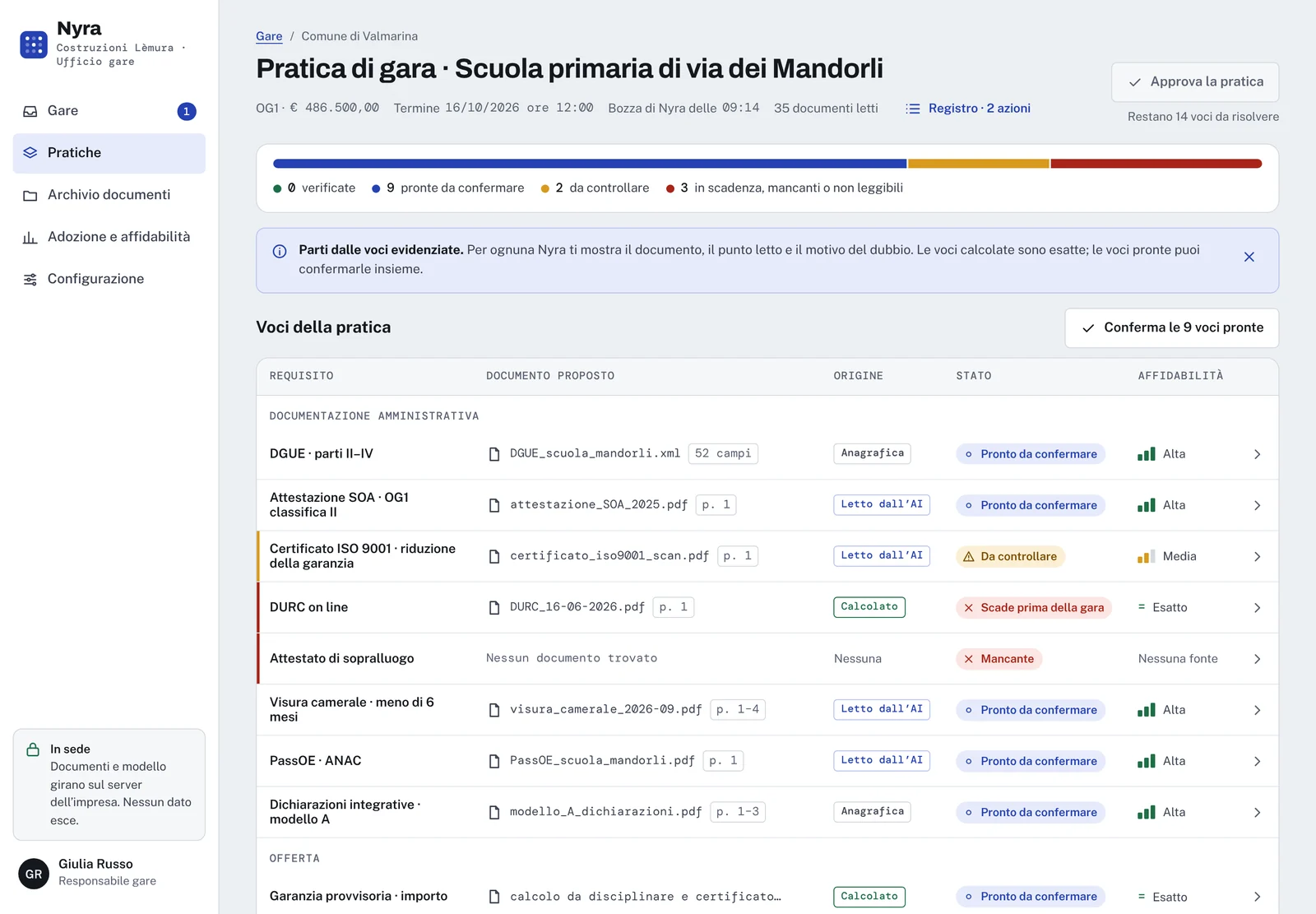
The draft
First the summary, then the source of each piece of data
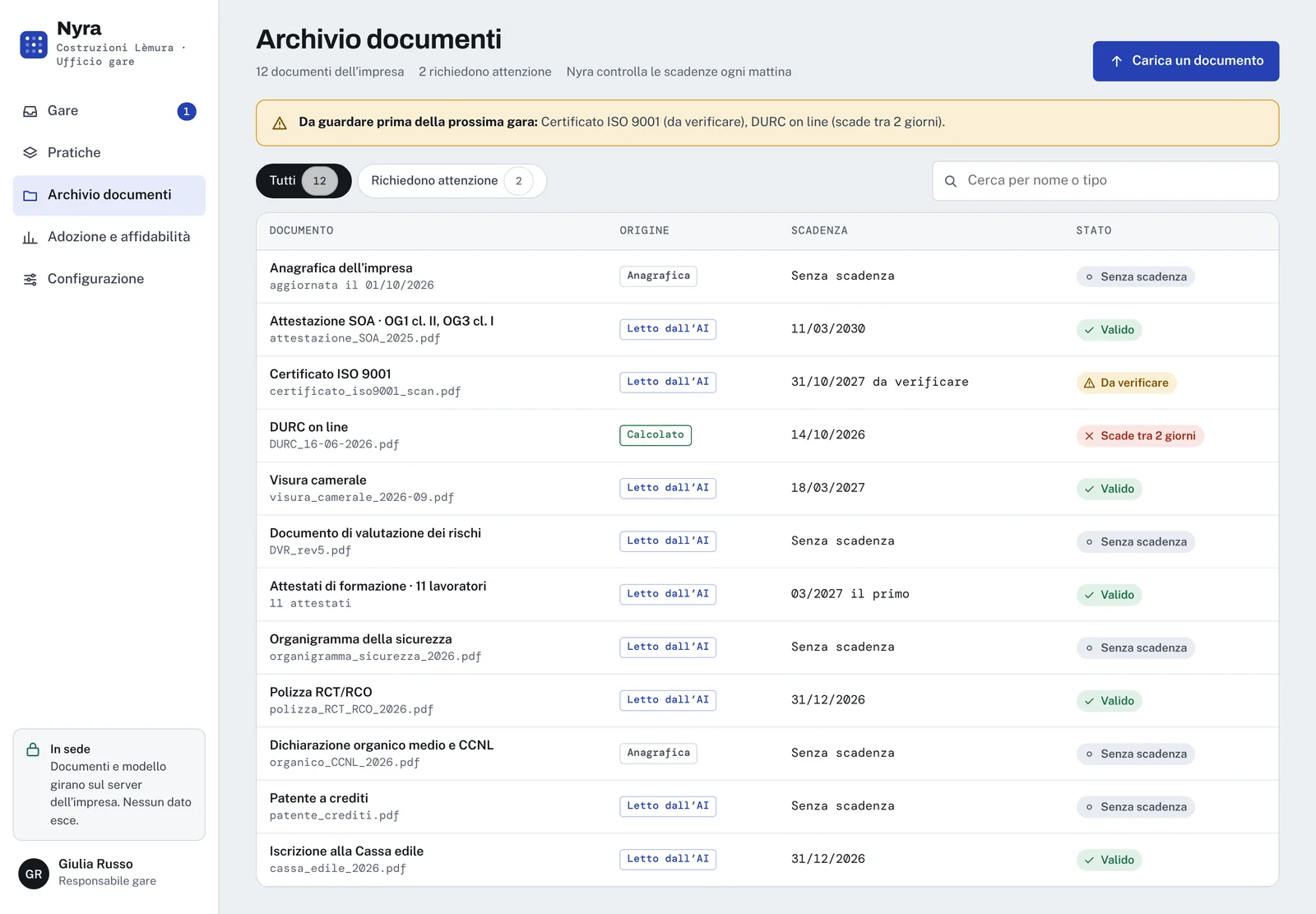
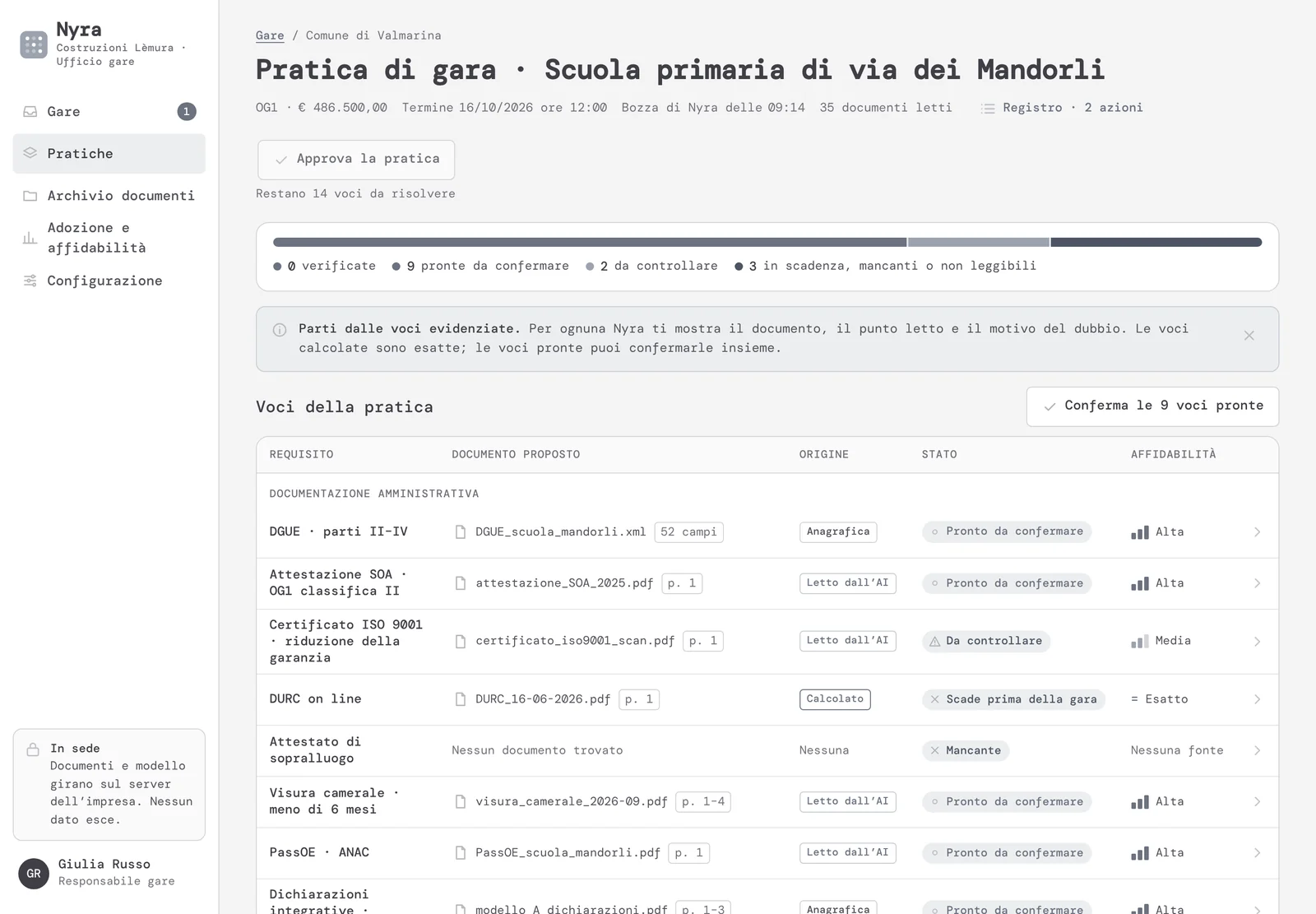
The bar says how many items need attention. The Source column separates what is calculated from what the AI has read.
Open in the prototype →Case study · Product design for AI · Product and concept
An AI system that is configured around the documents, rules and roles of each company. In the case study it prepares the tender files of a construction company, and the person responsible checks them item by item before signing.
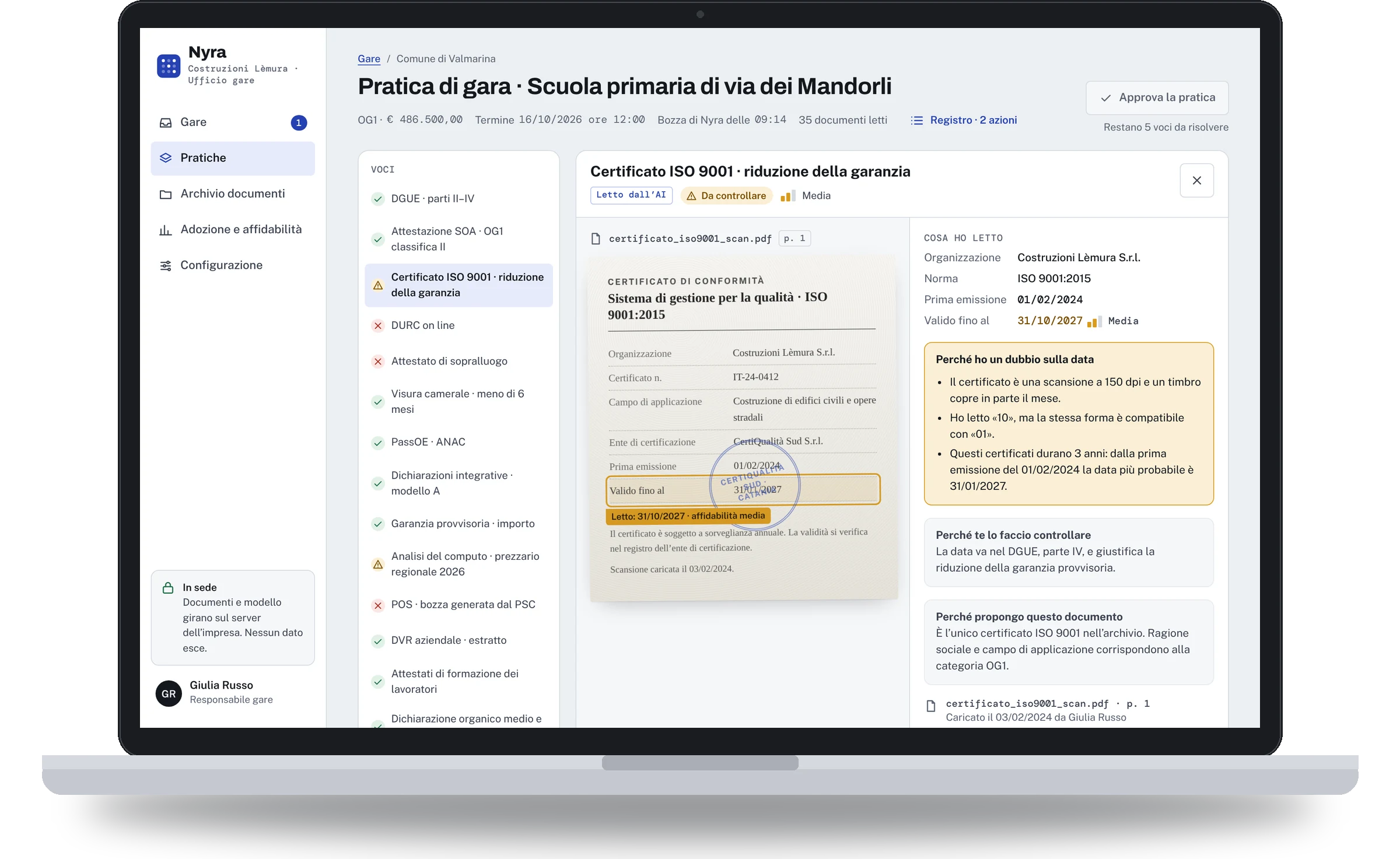
A person who signs a file prepared by AI must be able to trust every item.
Every piece of data says where it comes from and how certain it is. The code does the calculations.
A system that can be configured for any company, and a prototype with 21 states to try.
of European tech professionals delegate documentation to AI. It is the task they delegate most often.
Shakers, State of European AI Builders 2026, p. 12have at least one AI agent or automated workflow in real work.
Shakers, State of European AI Builders 2026, p. 12The weak point is the move into production. For 37% of people who worked on AI projects in the last year, less than half of them reached production.
Source: Shakers, State of European AI Builders 2026, p. 12. Up to three answers per person.
In August 2026 Shakers surveyed 1,035 tech professionals in 23 European countries. In the Italian sample, which is small and so only indicative, 87% have at least one agent in real work and 80% see European regulation as a professional advantage (p. 33, n = 70).
An expert quoted in the report notes that the barrier to adoption is cultural, and is about internal readiness more than budget (p. 18).
Delegating the file to AI without losing control over what you sign.
Today each tool works on its own. It does not see the whole file, it cannot tell a calculated number from one read on a scan, and it cannot show how the file was prepared.
Without interviews, I worked with a proto-persona and a map of hypotheses, stated as such. In the prototype the company is invented: Costruzioni Lèmura, with an equally invented tender from the Municipality of Valmarina.
“When a tender is published, I want to know at once what is missing, what is expiring and what is uncertain, so I can send a complete file without checking everything again from the start.”
Secondary users. The site surveyor completes the POS but does not approve it. The legal representative signs. The labour consultant and the contracting authority receive the requests. Management looks at adoption and reliability and decides whether to renew the subscription.
Nyra is the brand that LL Studio and PV Design use to present a single offer. I combined its real product with a review concept.
Rules already tested with a pilot company.
Item-by-item review, with the source always in view.
It uses the existing tools and shows where each piece of data comes from.
The AI interprets. The code calculates. A person checks and signs.
The AI interprets. It reads documents and scans, and says how certain it is.
The code calculates. Guarantees, deadlines and comparisons follow fixed rules.
The person decides. Uncertain items are opened one by one, and approval cannot be skipped.
The number says how much, but not why.
The confirmation covers the whole document at once.
Attention goes only where it is needed.
The guarantee, the deadlines and the bill of quantities analysis show “Exact”; confidence applies only to what the AI has read.
In the interface: the data source and the “How I calculated” box.
If a document is missing, the field stays empty and the system says where it looked.
In the interface: the “Missing” state and “Where I looked”.
Uncertain items cannot be confirmed all at once. A person sends the requests.
Among the barriers to production, the report mentions unclear responsibilities (p. 15).
Before every update the system runs the tests with known results again, and the result is visible.
In the interface: the test bench in Adoption and reliability.
An item with medium or low confidence must be opened, and approval stays blocked until it is resolved.
In the report, an expert says they look for people who have learnt to delegate with a method (p. 18).
File, page and the field that was read, highlighted. The file goes out with a statement on how it was prepared.
Transparency and explainability in design (Adigital in the report, p. 26).
Today Nyra AI Tools runs on Base44. The concept also includes processing on the company’s own server: trust and privacy come first among the European advantages named by professionals (50%, Shakers, State of European AI Builders 2026, p. 43, base 1,039).
From the tender notice to the approved file: 21 states you can navigate, no empty screens. Each image opens the prototype at the right point. The prototype is in Italian.
The bar says how many items need attention. The Source column separates what is calculated from what the AI has read.
Open in the prototype →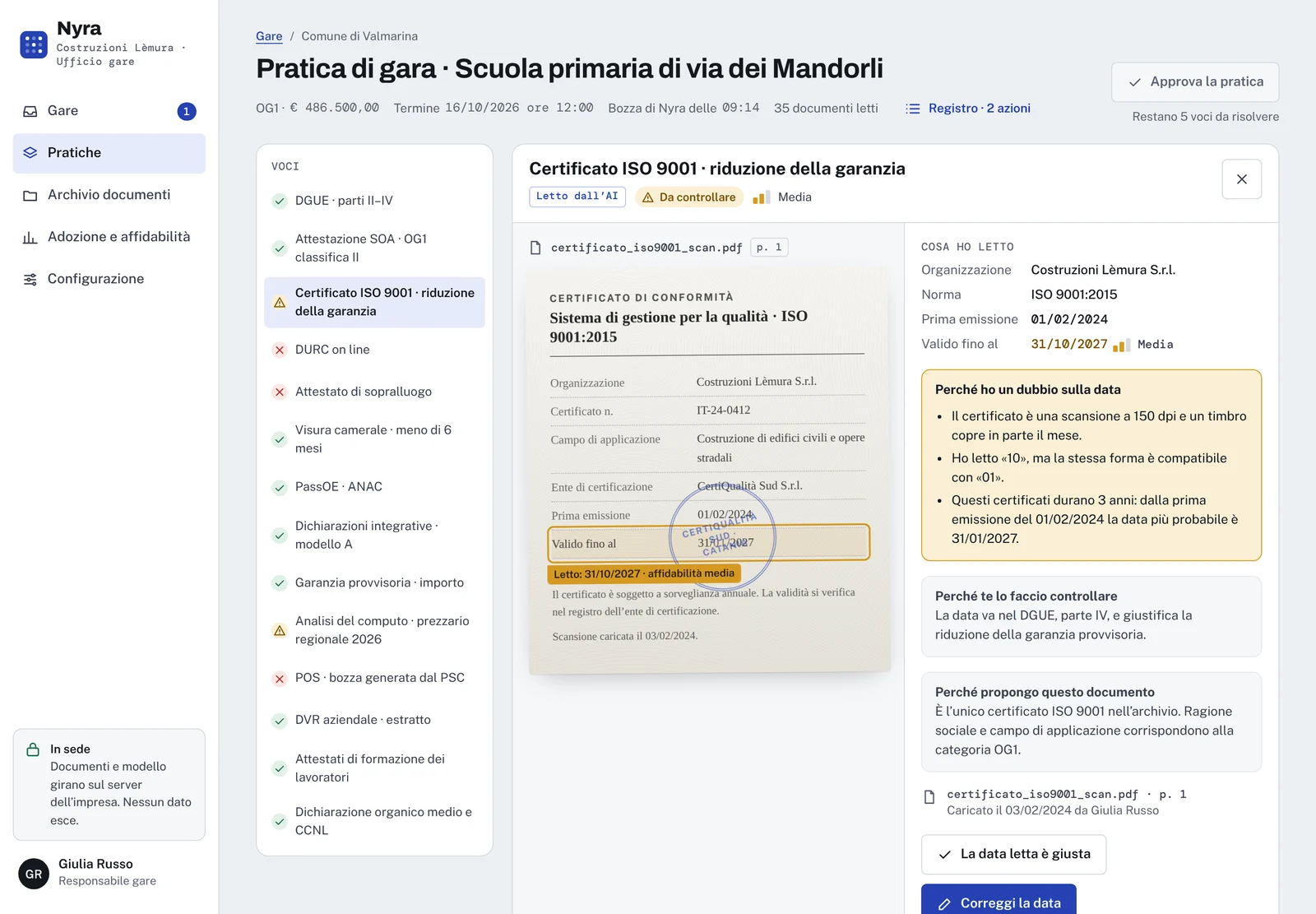
The field that was read is highlighted on the scan, with the clues behind the doubt and the most likely alternative.
Open in the prototype →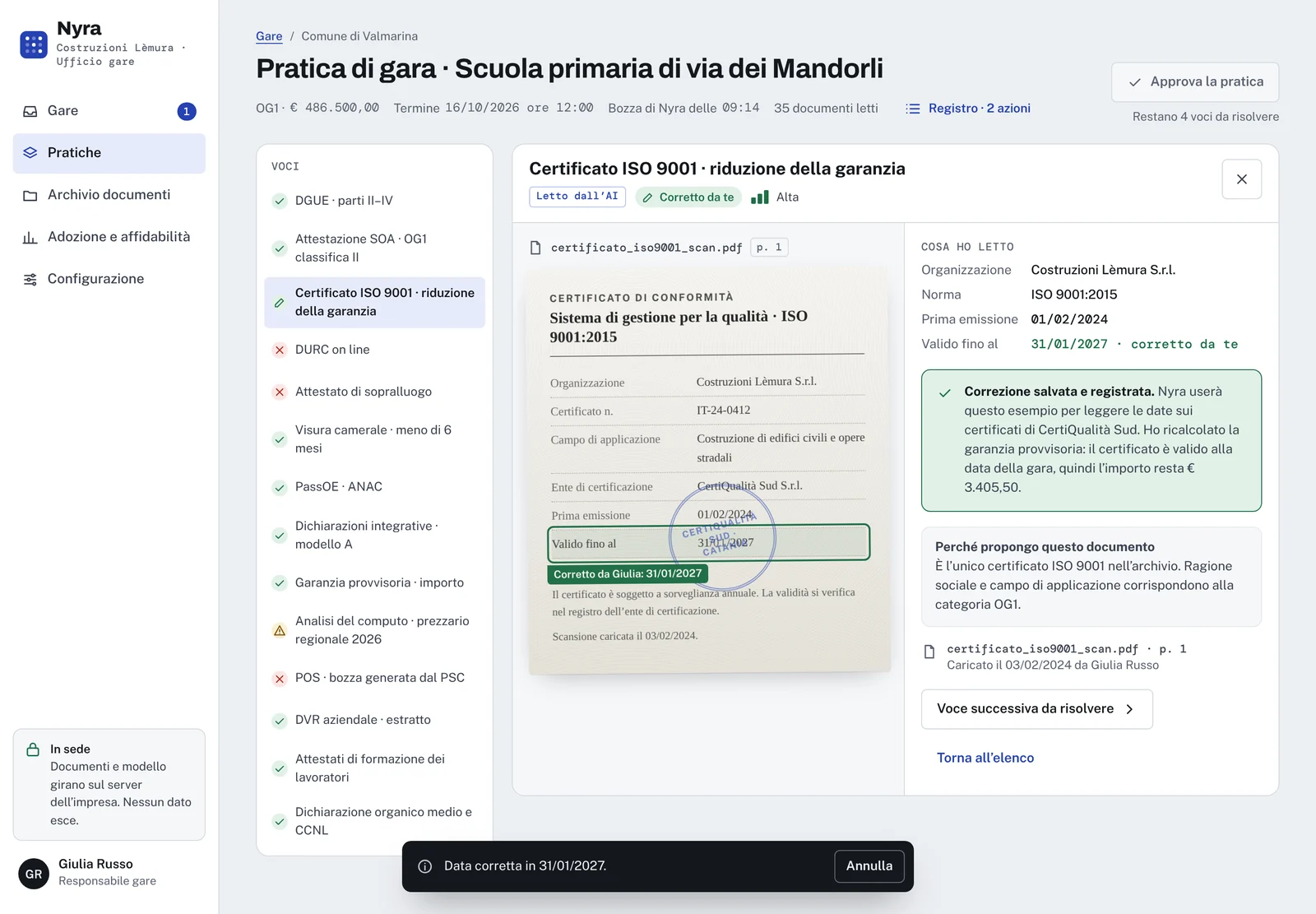
You can undo it with one click, it stays in the log, and it automatically recalculates the guarantee that depends on that date.
Open in the prototype →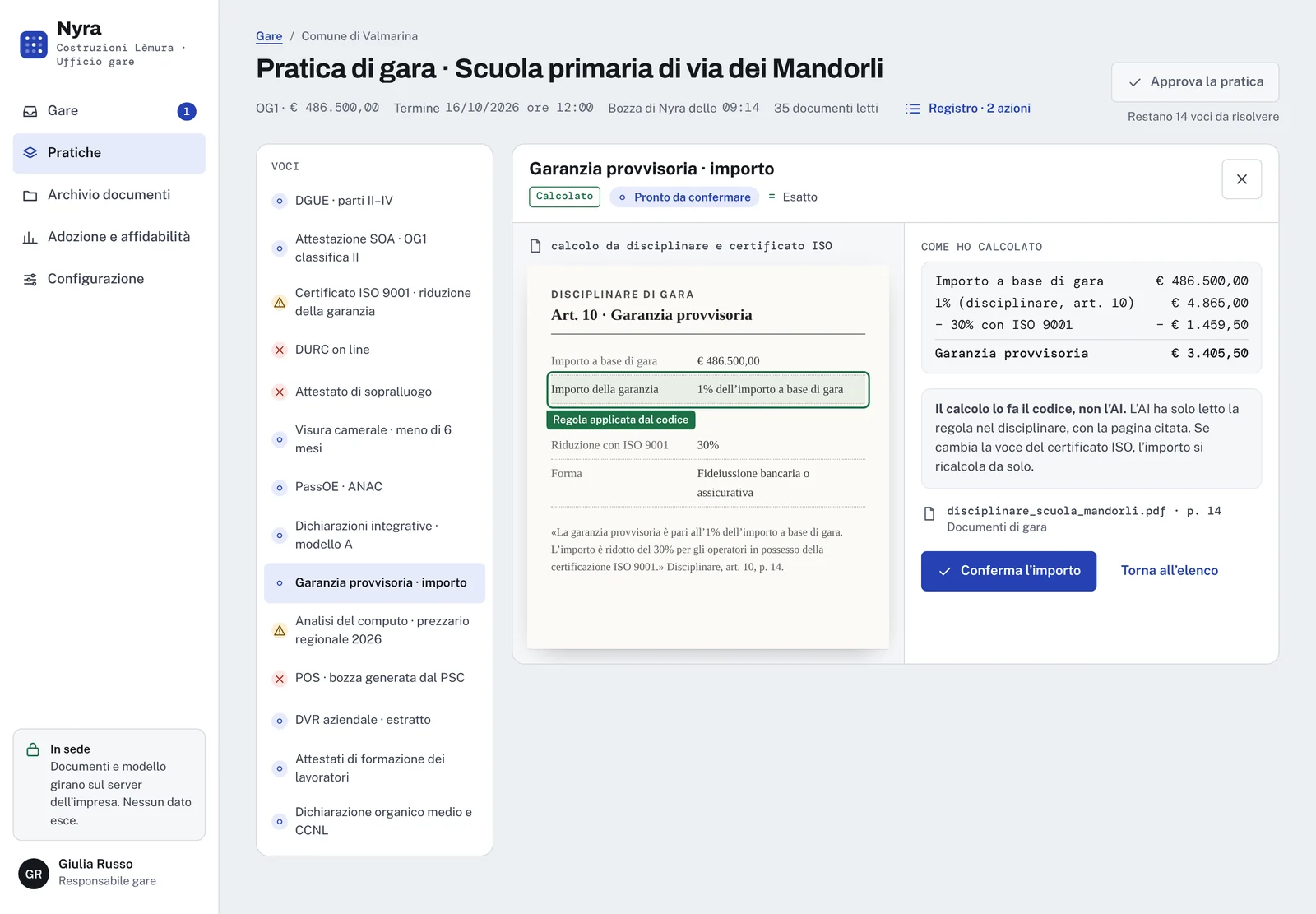
Calculated numbers have no confidence level: they have the step-by-step calculation and the rule from the tender specifications.
Open in the prototype →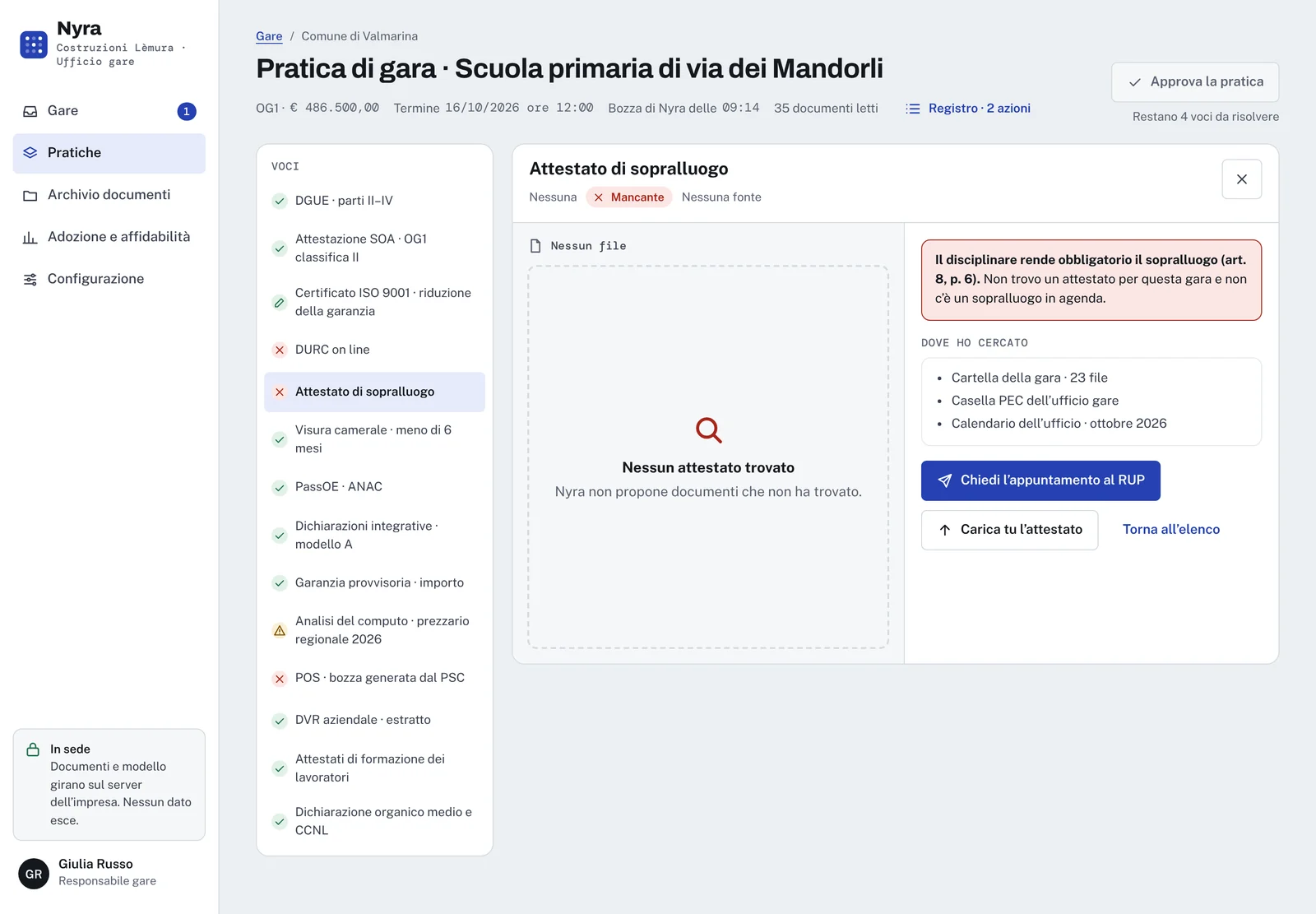
No invented documents: the system shows where it looked and prepares the request to the RUP, which a person sends.
Open in the prototype →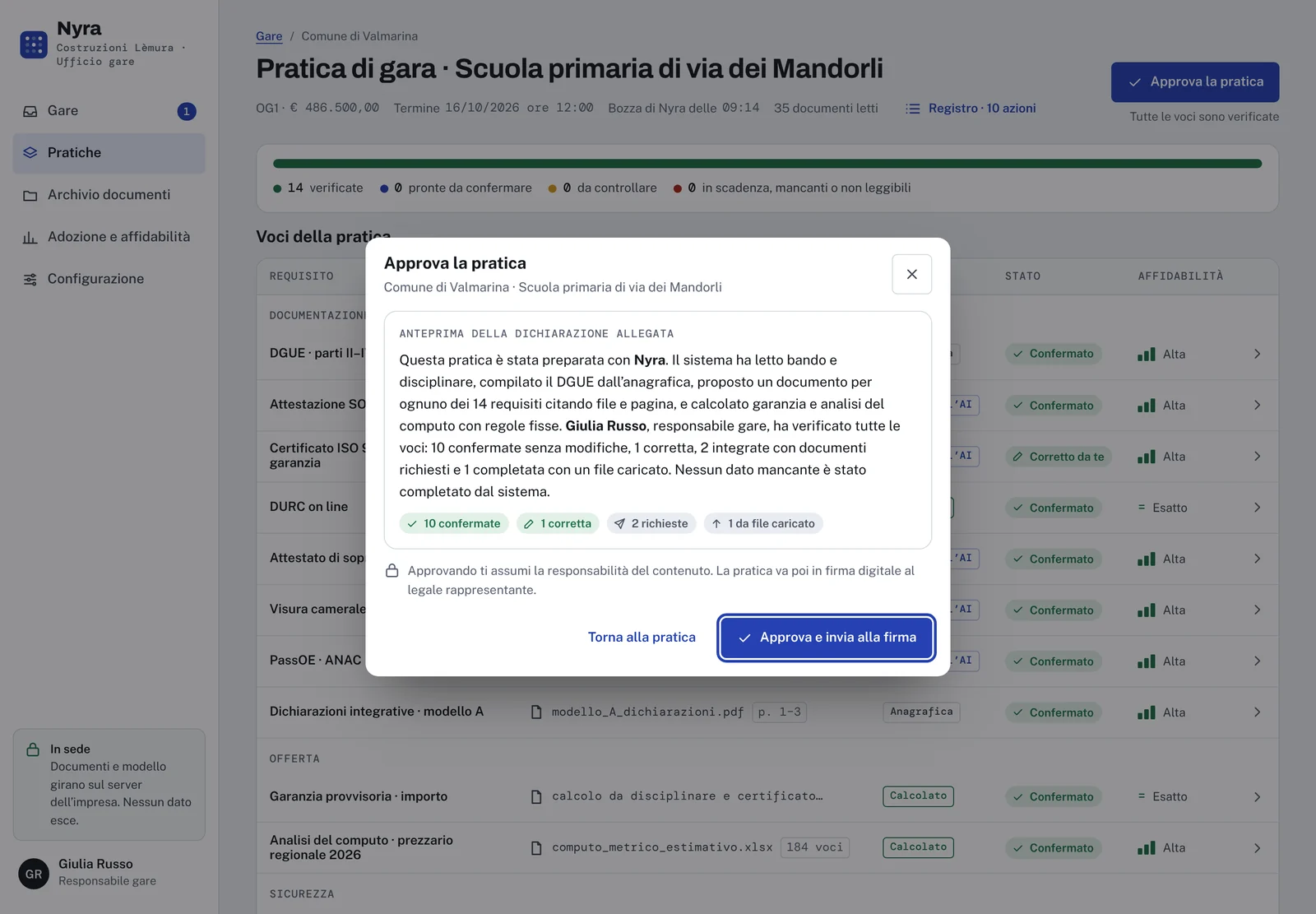
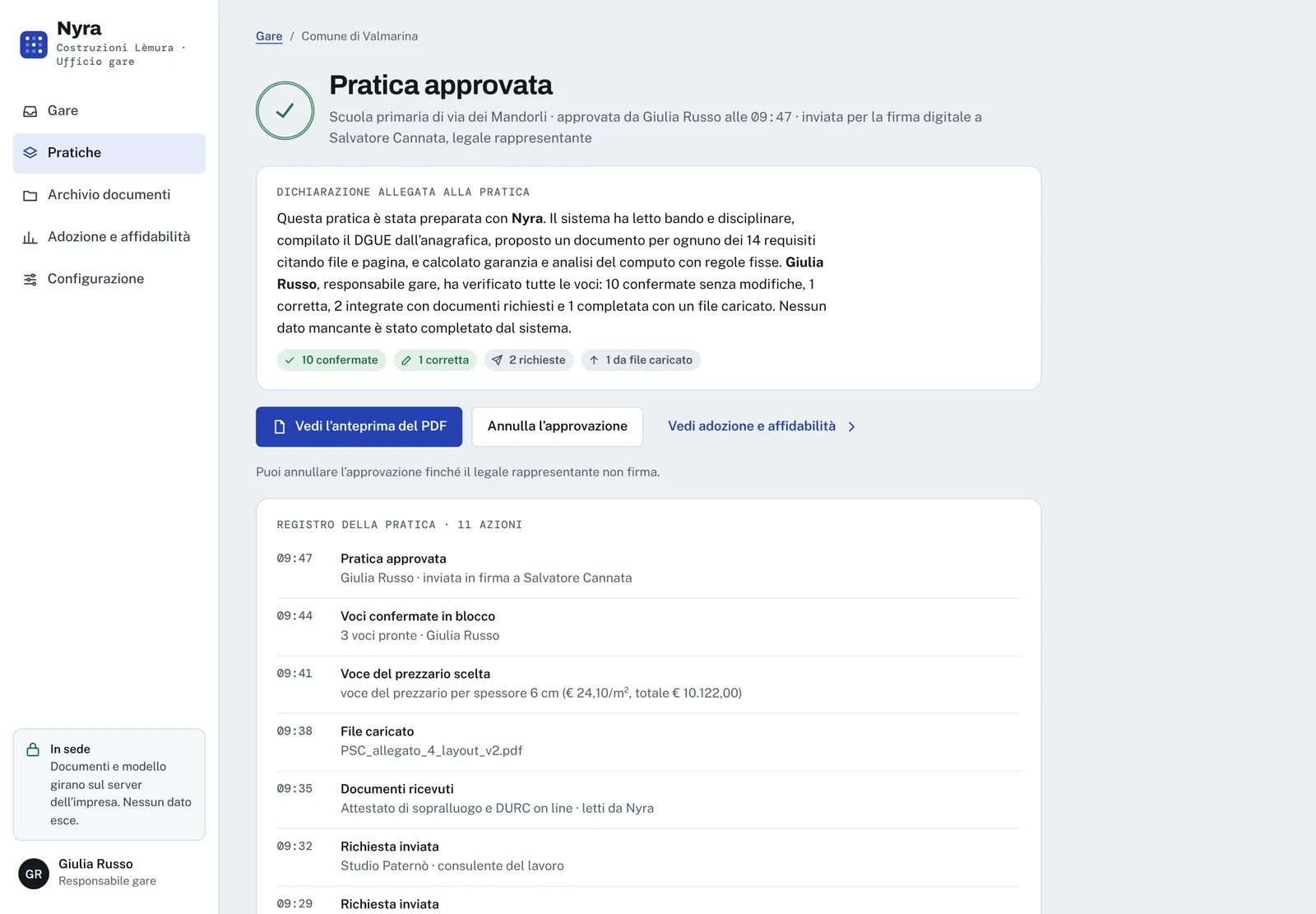
Before approving, the manager reads what the system did and what she checked herself. Then the file goes for signature.
Open in the prototype →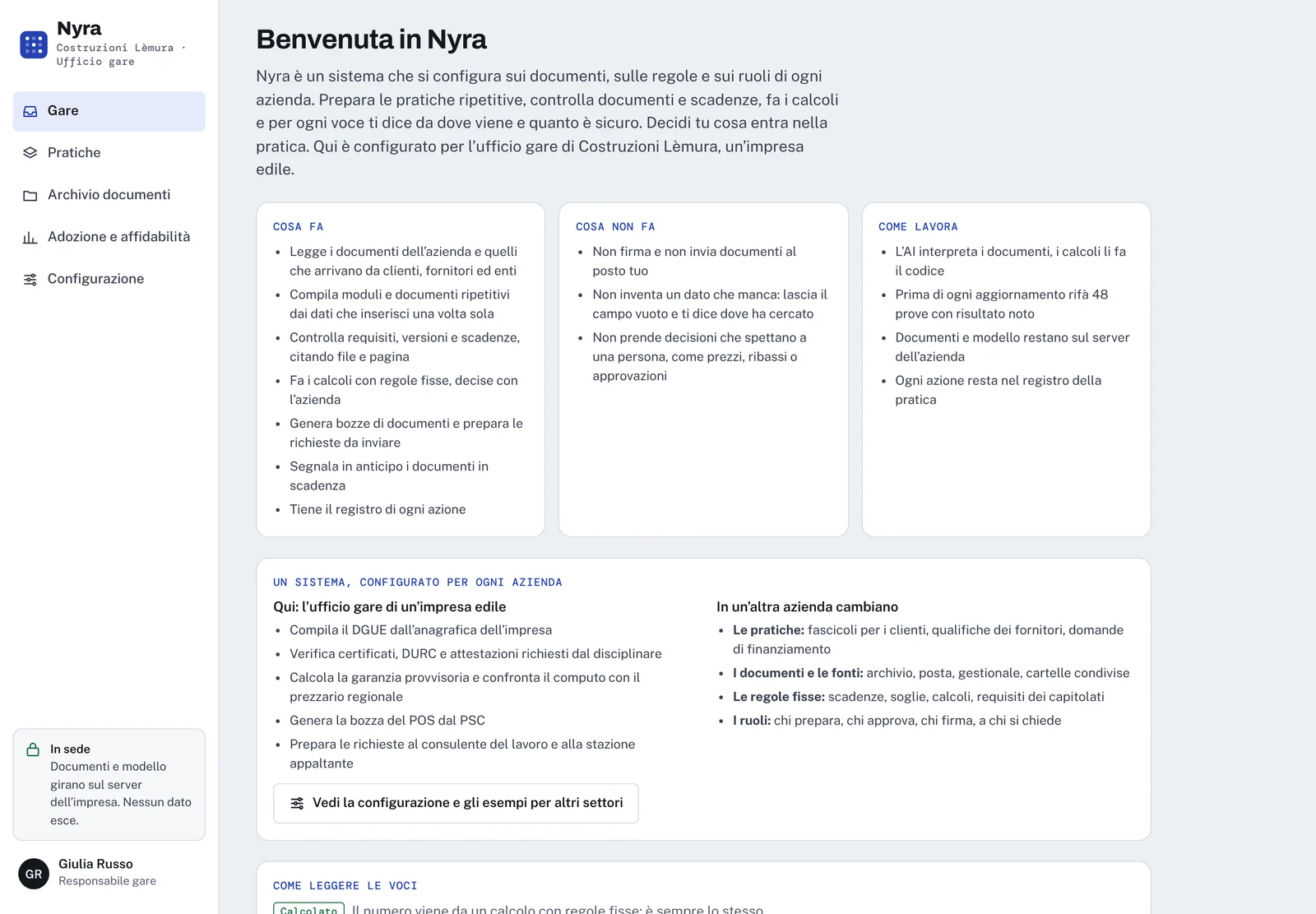
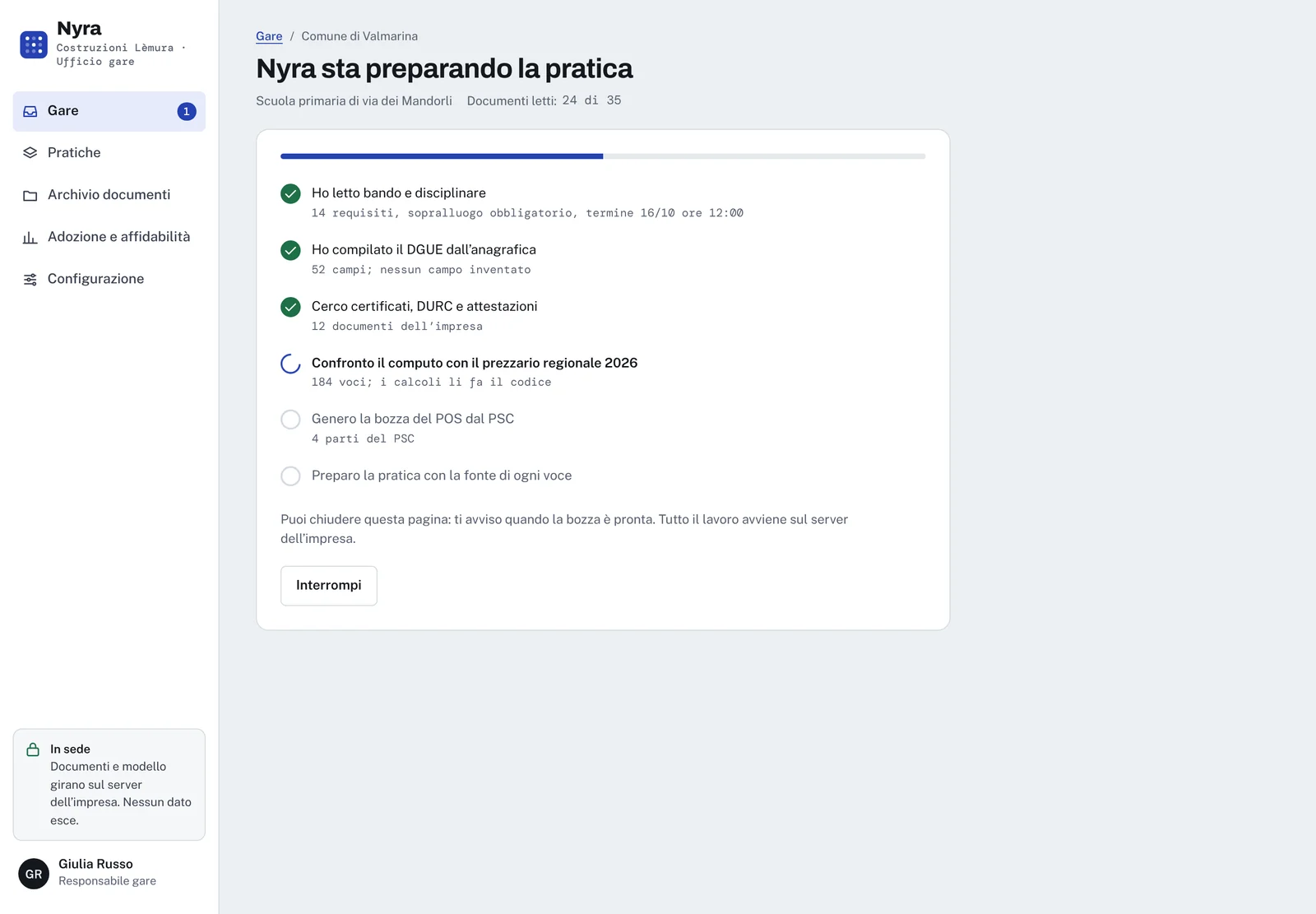
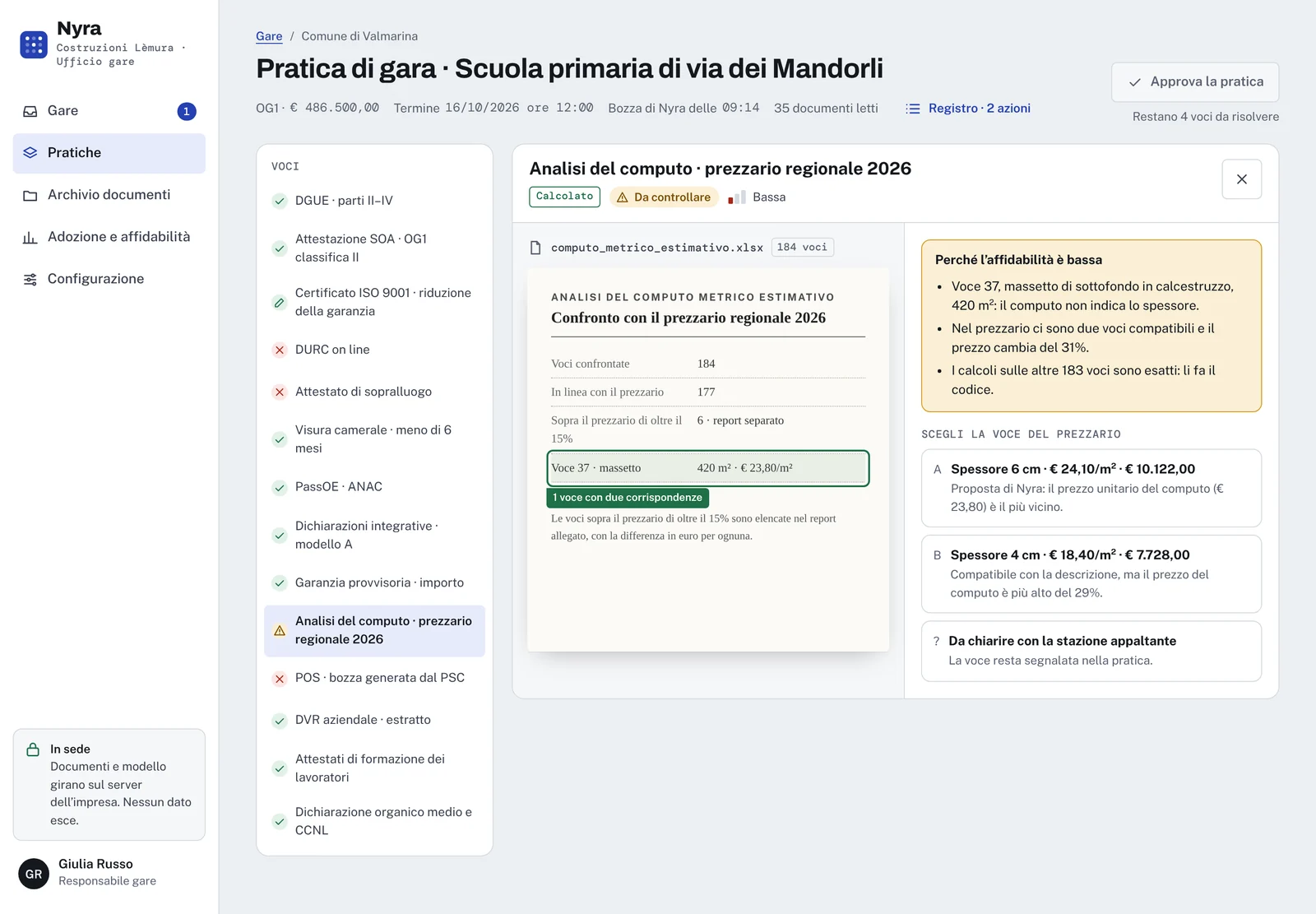
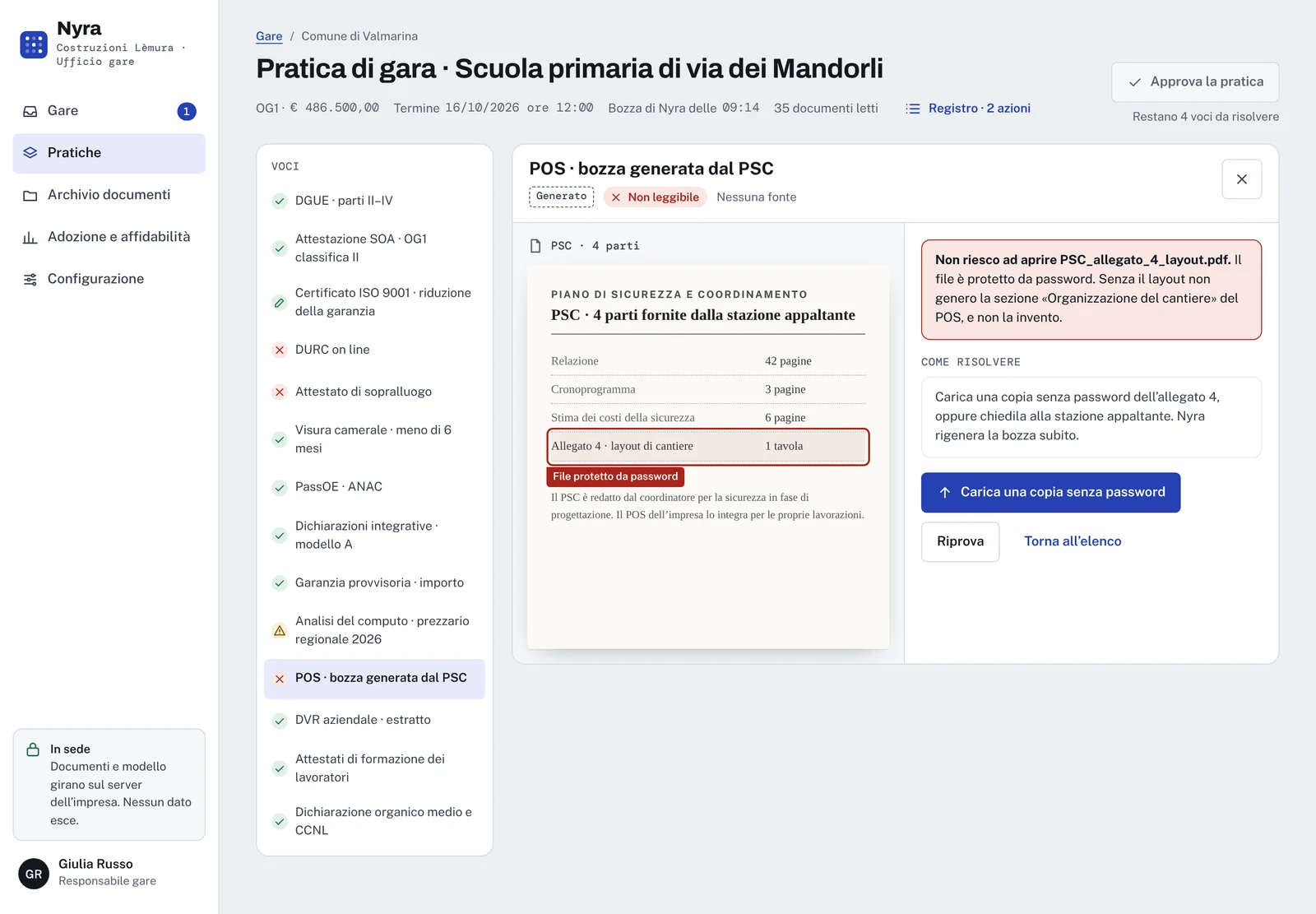
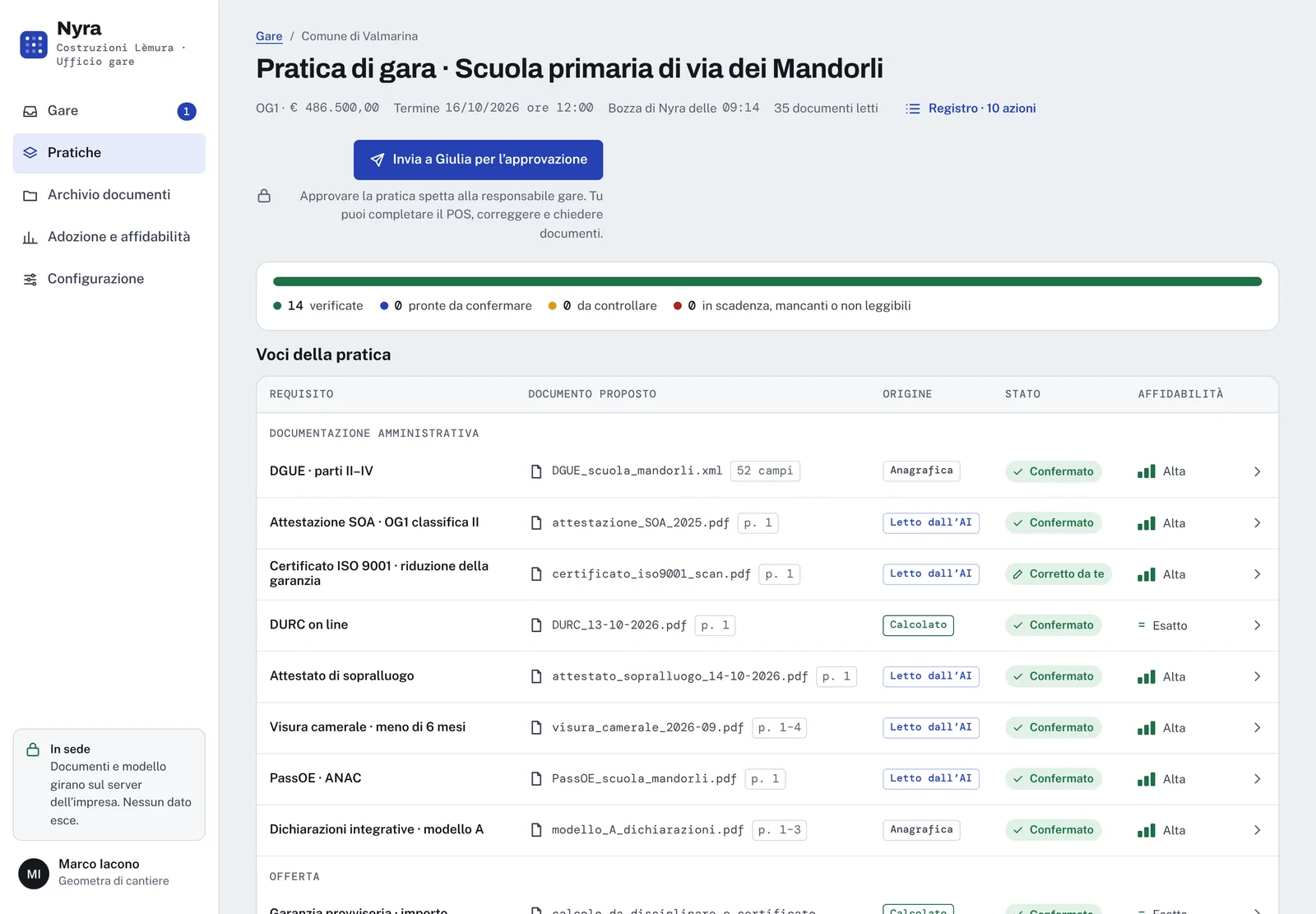
How much attention a piece of data deserves, before you read it.
Bars and a word: you can read it without colours too.
File and page, with the field highlighted.
Answers always in the same order.
It can be undone, it is logged, and it recalculates what depends on it.
The best way to understand it is to try it: correct a date and watch the guarantee change.
Try the uncertain dataEvery company prepares repetitive files that someone must sign. Nyra is configured around its documents, its rules and its roles; the way of checking stays the same.
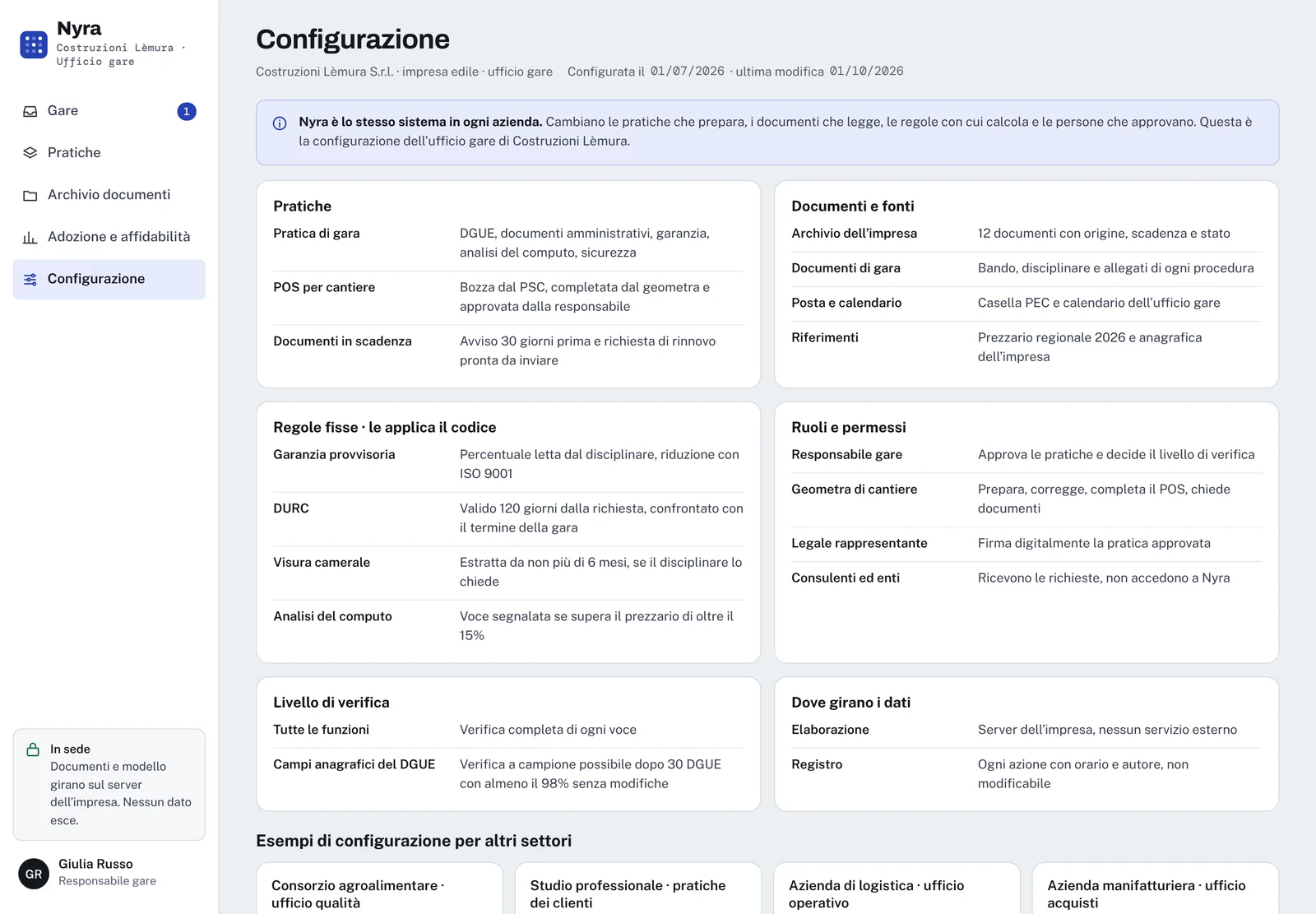
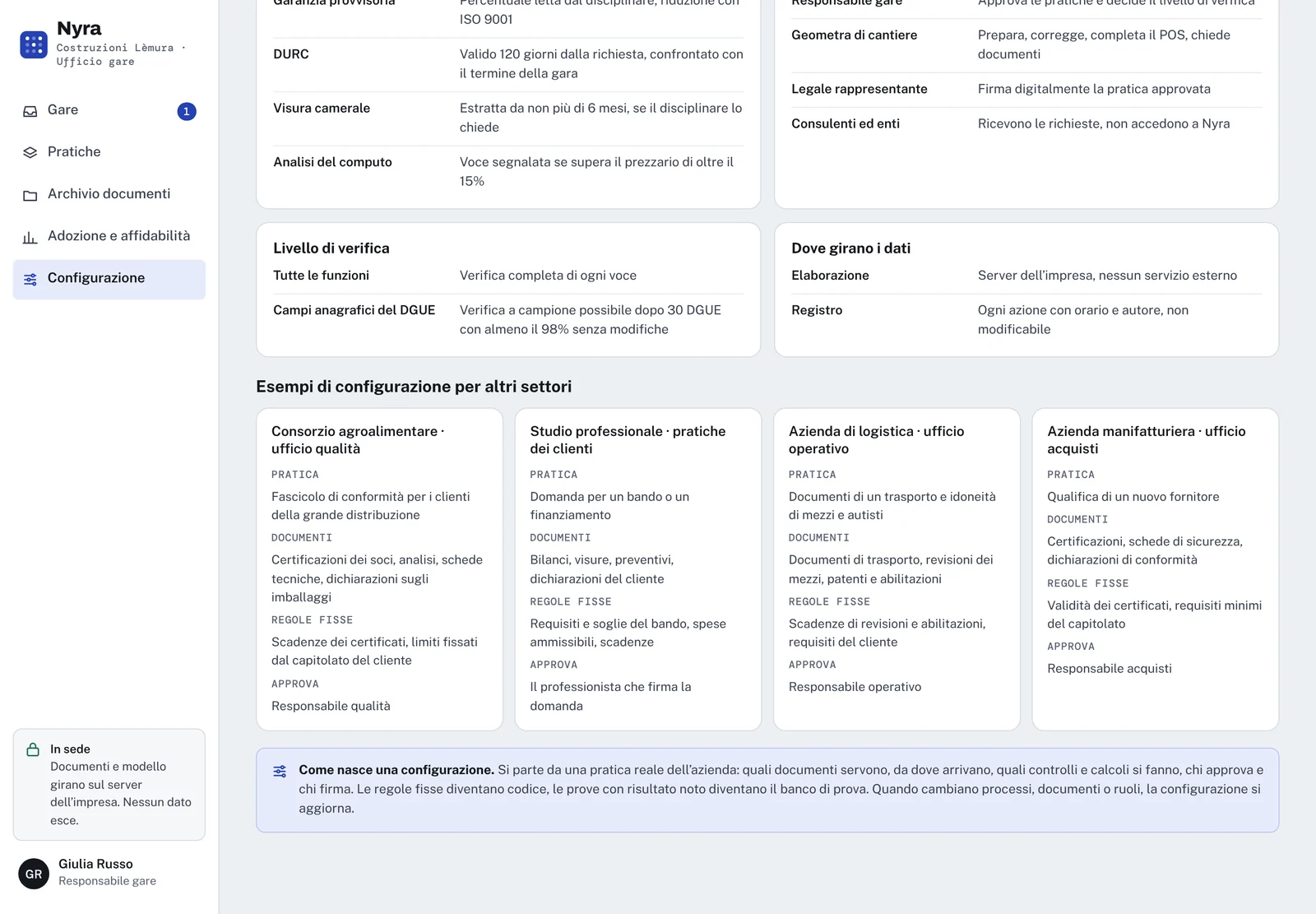
The configuration is visible: which files the system prepares, which sources it reads from, which rules the code applies and who approves.
Open the configuration →| Company and office | File | Documents and sources | Fixed rules | Who approves |
|---|---|---|---|---|
| Construction company · tender officeThe prototype case | Tender file and POS | Tender notice, tender specifications, certificates, DURC, PSC, regional price list | Provisional guarantee, DURC validity, deviation from the price list | Tender manager; the legal representative signs |
| Agri-food consortium · quality office | Compliance file for large retail clients | Members’ certifications, lab tests, technical data sheets, packaging declarations | Certificate expiry dates, limits set by the client’s specifications | Quality manager |
| Professional firm · client files | Application for a call for funding or a loan | Financial statements, company register extracts, quotes, client declarations | Requirements and thresholds of the call, eligible costs, deadlines | The professional who signs the application |
| Logistics company · operations office | Documents for a transport, and fitness of vehicles and drivers | Transport documents, vehicle inspections, driving licences and qualifications | Expiry dates of inspections and qualifications, client requirements | Operations manager |
| Manufacturing company · purchasing office | Qualification of a new supplier | Certifications, safety data sheets, declarations of conformity | Certificate validity, minimum requirements of the specifications | Purchasing manager |
I gave my process the same rules as the product: the AI proposes, I check and decide, and every step leaves a trace.
Hierarchy, states and actions before colour and typography. Drag to compare.
The report text uses 1,035 responses, the appendix uses 1,039. Some numbers change by one point, and in one case the text rounds 32% to “half”.
| Data | Text | Appendix |
|---|---|---|
| Weekly use of ChatGPT | 70% · p. 11 | 71% · p. 40 |
| 1 to 2 agents in real work | 55% · p. 12 | 56% · p. 40 |
| No projects in production | 9% · p. 15 | 10% · p. 41 |
| Penalised after declaring the use of AI | 6% · p. 25 | 5% yes, 6% not sure · p. 42 |
| Time spent mostly directing the AI | “half” (32%) · p. 28 | 32% · p. 41 |
| Criterion | A · Pilot → adoption | B · Agent supervision | C · AI literacy | D · B + adoption + transparency |
|---|---|---|---|---|
| Strength of the evidence in the data | 4 | 3 | 3 | 4 |
| Relevance for people hiring on Shakers | 3 | 5 | 2 | 5 |
| UX depth I can show | 3 | 5 | 3 | 5 |
| Feasibility in the time available | 2 | 4 | 3 | 3 |
| Link with LL Studio | 5 | 4 | 4 | 5 |
| Value for a hybrid profile | 4 | 2 | 5 | 5 |
| What it adds to my case studies | 3 | 3 | 3 | 5 |
| Total out of 35 | 24 | 26 | 23 | 32 |
The first concept applied D to the quality office of an agri-food consortium. When I combined it with Nyra AI Tools, I moved the scenario to tenders and safety in construction, where the product is already in use.
| Phase | What the AI did | What I decided | How I checked |
|---|---|---|---|
| Brief | It reread the brief and flagged the data to check before using it. | The AI’s role, selection criteria, honesty rules, checkpoints. | A checkpoint at the end of each phase. |
| Report | It read 44 pages as images and compared every number with the text and the appendix. | The citation rule and the data to exclude. | Every number on this page shows its page in the report. |
| Problem | It assessed four options on seven criteria. | Combination D and a concept scope: no interviews, persona and scenario stated as hypotheses. | Scores reviewed after a full reading of the report. |
| Merge | It compared the concept with Nyra AI Tools and moved the scenario to tenders and safety in construction. | To merge the two projects under the name Nyra and to start from the principles of the real product. | No invented product usage data. |
| Prototype | It wrote HTML, CSS and JavaScript for 21 states and five components for AI, with no empty screens or fake buttons. | Critical flow, required states and rules: the system does not sign, does not send and does not invent data. | Full path in an automated browser; calculations redone by hand; contrast above 5:1; no horizontal scrolling at 1280, 768 and 390 px. |
| Page | It produced screenshots, mockups and the layout in the series of my case studies. | Texts, microcopy and data, reviewed before publication. | A “fictional” or “to be validated” stamp on every piece of data that is not real. |
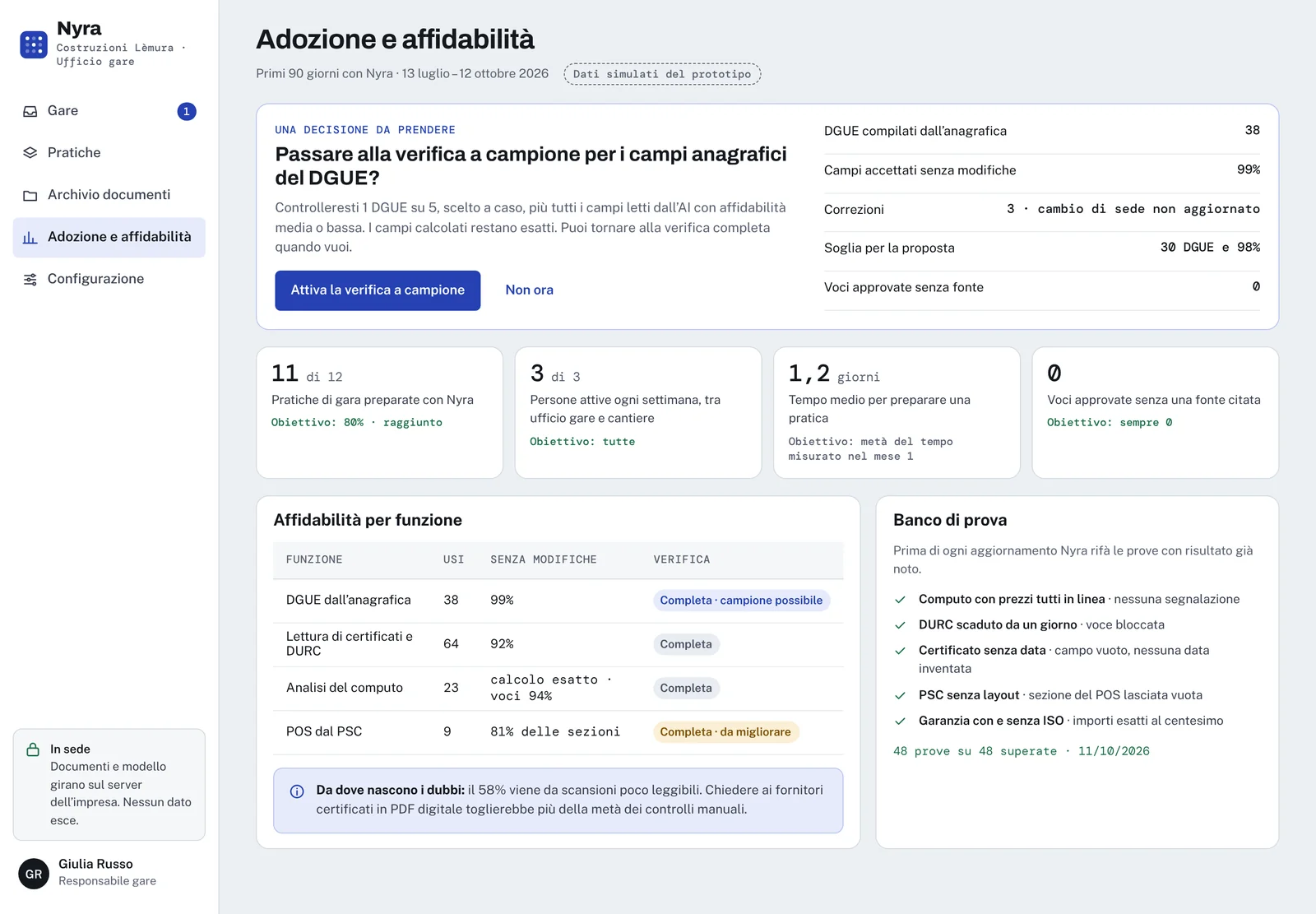
Project targets, not results. The 90 days come from the report’s definition of production (Shakers, State of European AI Builders 2026, p. 9).
Five tasks with 5–8 people from tender offices, then the AttrakDiff questionnaire. Target: pragmatic quality of at least 5 out of 7.
I will measure completion, errors, times and AttrakDiff, as in my other case studies. Targets: at least 4 tasks out of 5 without help, no uncertain item confirmed without opening it, everyone can tell calculated data from data read by the AI, pragmatic quality of at least 5 out of 7 (reference: 5.38 for Simplify Review).
Rules already tested, and a sector where an expired document costs you the tender.
Saying whether a number is calculated or read takes the eye where it is needed.
The differences in the report only came out by comparing every number with the appendix.
Correct a date, change role, upload a file the system does not recognise. Nyra must hold up, and always tell you why.