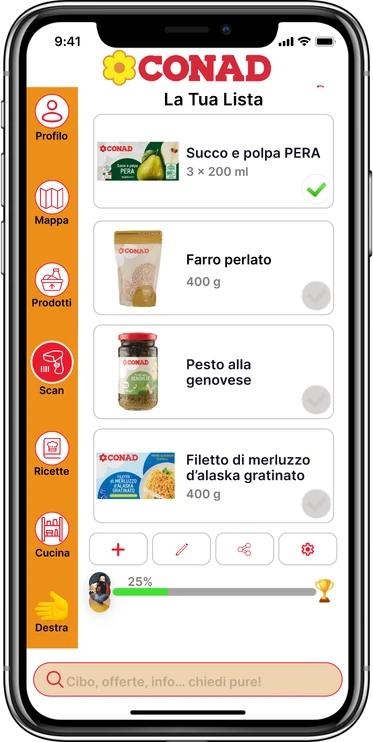
Your list
You tick off the list in the shop and a bar shows your progress. Buying only what you need becomes a small goal.
Case study · UX Research · Mobile app
A grocery shopping app that reduces food waste from the moment you decide what to buy.
Open the Figma prototype (opens in a new tab)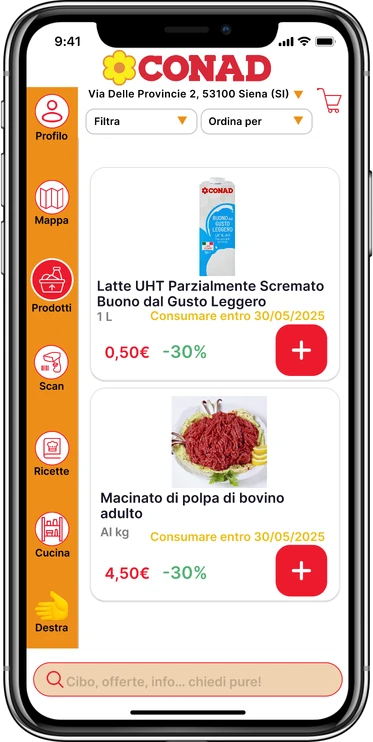
The problem
Along the supply chain, food is lost in the fields, in storage and in transport. But real waste is concentrated at the end, in retail, food service and households. In Europe, households produce 54% of the total.
kg of food thrown away per person per year
Source: Waste Watcher Observatory, 2022–2024
grams per person per week
Almost all are fresh products, with a short life and a date to keep an eye on.
of consumers plan their meals for the week.
cannot or do not want to reuse leftovers in a creative way.
of food wasted per person in the EU in 2022, of which 72 kg at home.
Sources: Confcommercio 2024; Eurostat 2022.
The research · my contribution
I worked on the research phase: from context data to people. Each step narrowed the focus, until we reached the insight that guided the project.
Data from Waste Watcher, Eurostat and Confcommercio to measure the problem and to separate food loss (the start of the supply chain) from food waste (the end of the supply chain and homes).
I analysed the existing anti-waste apps and their common features. Almost all of them act at the end of the chain, on food that is already surplus.
We asked people what frustrates them most when they go food shopping. Product expiry dates are in second place, ahead of queues.
Number of answers. To use more technology when shopping, people ask for exclusive offers (11) and time savings (8).
I read hundreds of comments under videos about food shopping on TikTok, Instagram and Reddit. The problem already starts with the list.
The data and the comments became two personas. Maria represents people who love cooking but have little time for shopping.
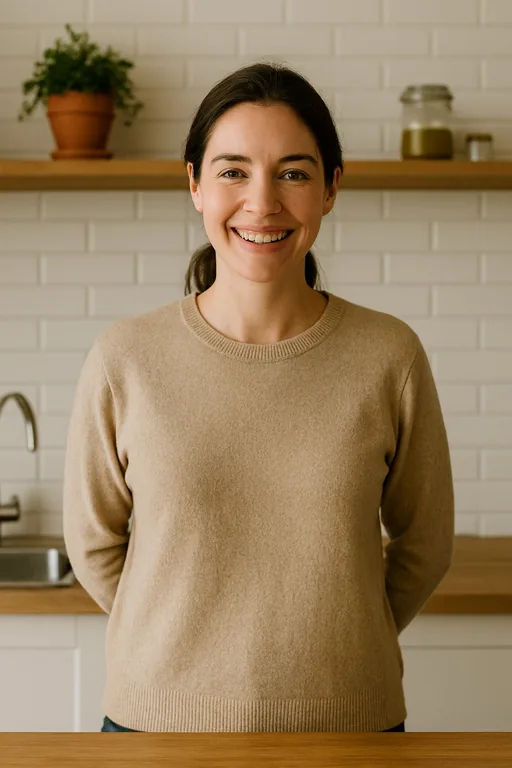
Maria, 49 years old
“Shop fast, cook with love.”
She cooks for her family and tries to follow the seasons. She wants to shop quickly so she has time to cook. Sometimes frozen food is her best ally.
Insight
To really reduce waste, we need to act before the fridge: when people plan their shopping.
Working only on food that is already at home or already on the shelves is not enough. This is why we chose to design inside the experience of a supermarket: Conad, which works on sustainability with its members and producers along the whole supply chain.
The solution
Conapp connects your shopping to what you already have at home. Each product carries its date, and the app uses it to suggest what to buy, where to store it and what to cook first.
You tick off the list in the shop and a bar shows your progress. Buying only what you need becomes a small goal.
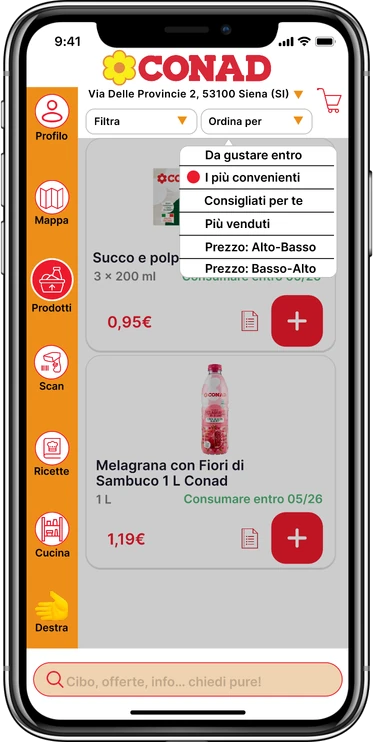
As well as by price and value, you can sort the catalogue by date. The expiry date is always next to the price.
Products close to their date are discounted and show “use by” clearly. People who buy them know when to use them.
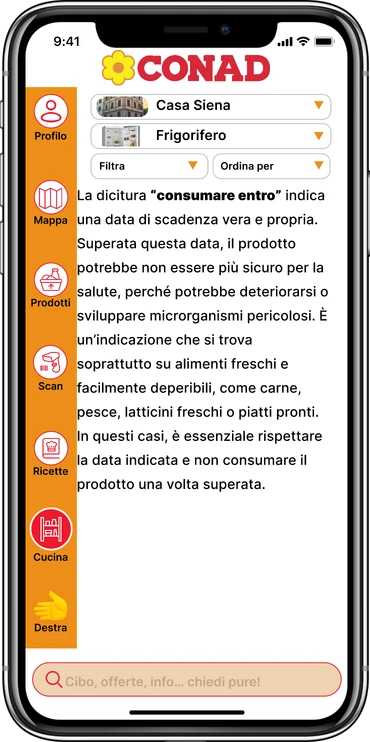
Pantry, fridge and freezer for each home, with the products and their dates. Short cards explain the difference between “use by” and “best before”.
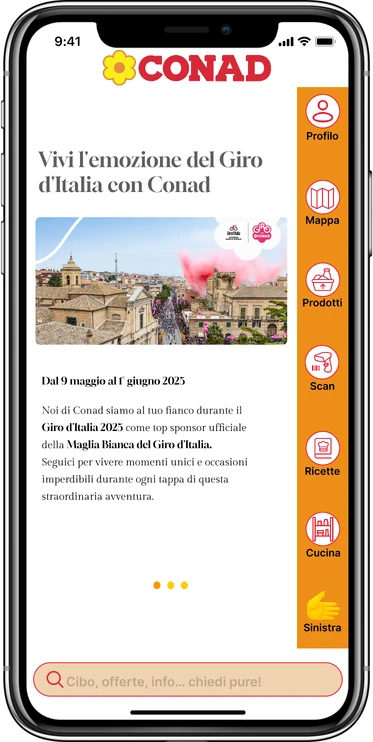
In the shop, one hand holds the trolley. The side bar moves from one side to the other with one tap, so every feature stays under your thumb.
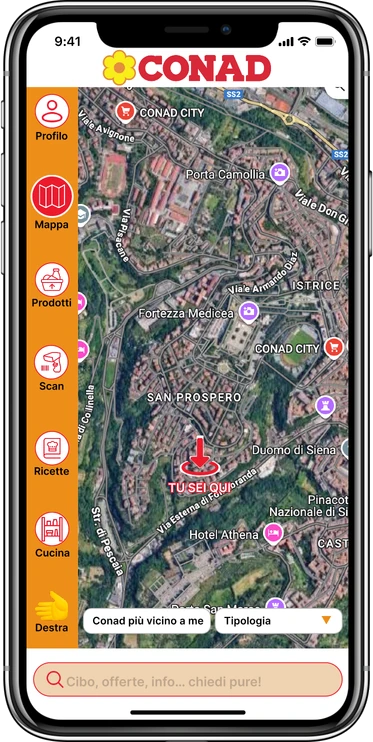
Map of shops with a filter by type. On every screen, the search accepts open questions: “Food, offers, info… just ask!”.
Beyond the screen
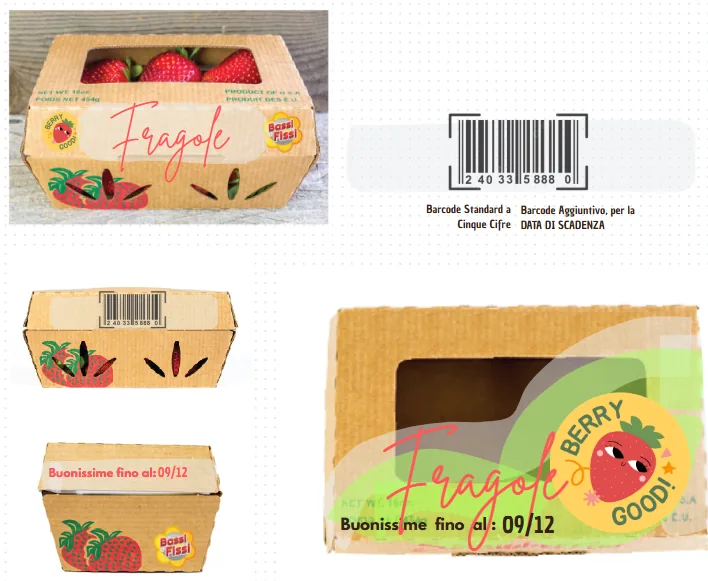
We redesigned the label for fresh products. The date moves to the front with a positive tone, and a second barcode makes it readable by the app’s scanner.

Validation
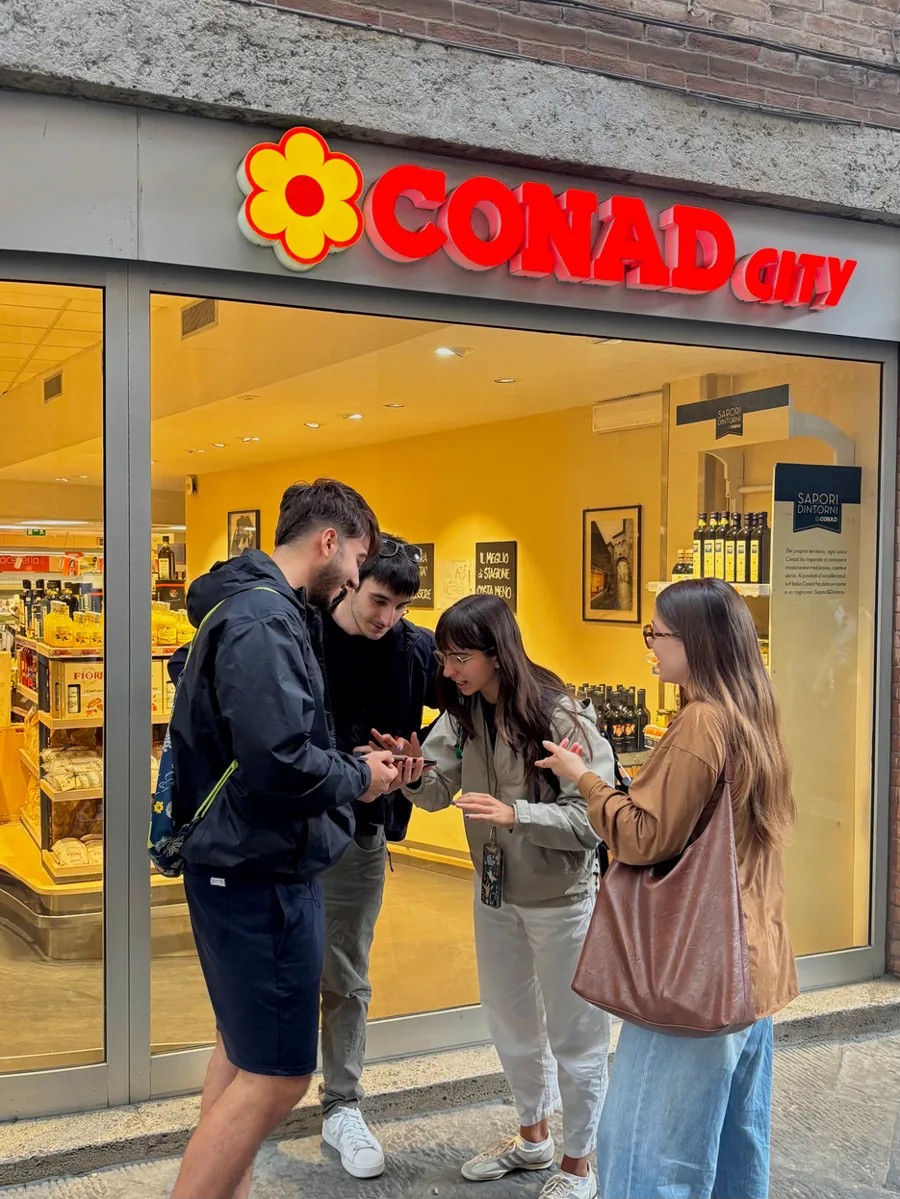
We asked 18 shoppers outside a Conad City in Siena to try the prototype, and we measured the experience with the AttrakDiff questionnaire.
Average of the answers on a 1–7 scale, n = 18.
Outcomes